Revolutionizing Water Management with iSnobal
Why we moved away from statistically-based water management models
For years, statistically based models have been the go-to for water resource managers, providing valuable insights. However, models relying on regressions from station measurements have failed to capture extreme events and irregular years.
For instance, the Tuolumne River Basin's drastic fluctuations in precipitation levels between 2015 and 2017 created prediction issues for resource managers. 2015 was the driest season for the region up to that time. 2016 was an average year. And 2017 was the wettest year ever recorded before it. A statistical model is highly unreliable with predicting that kind of volatility.
These limitations prompted the founders of M3Works to explore physically based alternatives like iSnobal, alongside other models such as Alpine3D, DHSVM, SnowModel, and WRF-Hydro. However, it was the rich legacy and trust of iSnobal that stood out, particularly its decades of use in government applications.
Data Validation
At the core of M3Works' approach lies a commitment to data validation and accuracy, in addition to iSnobal. We go the extra mile to validate data, using lidar flights for snow depth and multiple remote sensing platforms for albedo validation, information from SNOTELs, and collection of accurate forest height. M3Works ensures the fidelity of its models. We meticulously scrutinize areas where the model may deviate from reality, enabling continuous refinement and improvement.
 Comparison of modeled vs measured Snow Water Equivalent for Boise River Basin.
High Resolution & Real Time
One of the keys to M3Works' approach is the high-resolution, physically based modeling framework employed in real-time. Operating at a resolution of 50 meters, the model is not bound by geographical constraints and can be deployed across diverse basins. Currently, M3Works' model is operational in over 30 basins, reflecting its adaptability and scalability. Our model isn’t hyper-tuned to any one basin.
M3Works' transition to physically based modeling, anchored in iSnobal and emboldened by extensive validation, represents a paradigm shift in water resource management. By embracing innovative approaches and prioritizing data accuracy, we provide the most accurate realtime snowpack data commercially available.
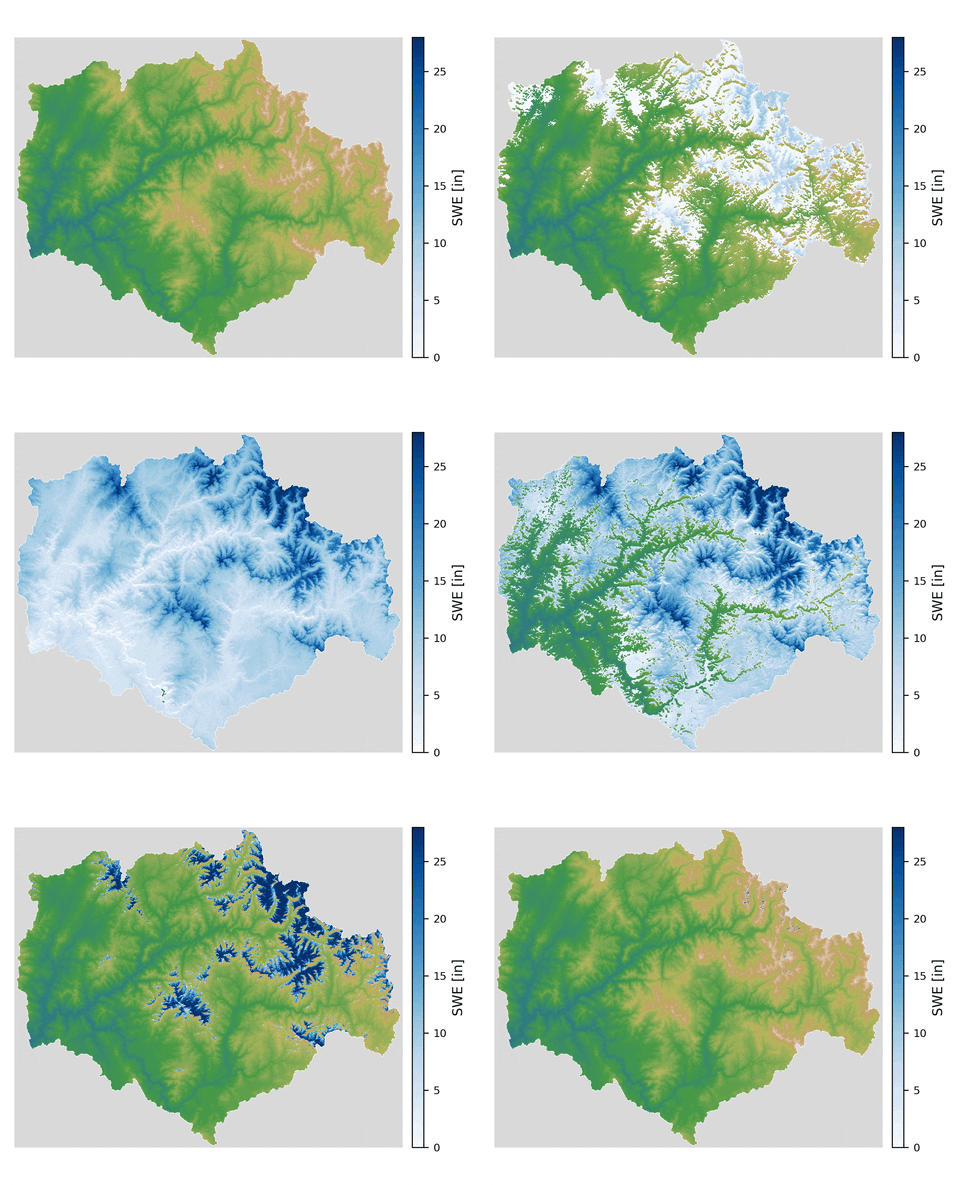
Model SWE for the Boise River Basin.
Micah Sandusky is a software developer, mechanical engineer, and scientific modeler. He started out using computational fluid dynamics to estimate wind power in mountainous terrain. He later launched into a snow hydrology career when he joined the USDA Agricultural Research Service to serve as the primary developer for the Automated Water Supply Model (AWSM), a framework now used by M3. Prior to cofounding M3 Works, Micah spent time as a developer in the commercial software industry where he cultivated his skills with data pipelines in the Cloud. At M3 Works, Micah coordinates our cloud infrastructure while developing new strategies for monitoring/maintaining our real time efforts to estimate snowpacks all across the Western US.
- M.S. Mechanical Engineering
- 10 years scientific modeling
- 10 years development experience
- 4+ years of Cloud experience

Solutions
Company
Resources
© 2024 M3Works. All rights reserved.