The Story Behind M3Works
The Origins Within the USDA
The story of M3Works highlights the transformative impact of academic research on the real world. Founders Mark Robertson, Micah Sandusky, and Micah Johnson met when they were hired by the United States Department of Agriculture (USDA) Agricultural Research Service (ARS) to help develop tools for snow modeling. The USDA had long been interested in using such models to improve water management in vulnerable regions. The USDA later teamed up with NASA’s Airborne Snow Observatory (ASO) to work on fusing aerial snow depth measurements with modeling, aiming to create the highest accuracy estimates of the snowpack ever formed.
The USDA along with the M’s pushed to take a snow model called iSnobal from research to operations through years of software development and collaboration with dozens of water managers throughout the California Sierra Nevada Mountains. That eventually became a technology transfer that is now M3Works. These technologies affect communities because of their accuracy. What started in a small research group is now being applied to make a difference for actual people. Many people may not understand what hydrology and environmental modeling mean, but they know water means life. Thats why M3Works is committed to handling water predictions with care.
The Technology
During their tenure at the USDA, the M’s were tasked with integrating aerial snow depth measurements while making it easier to run iSnobal anywhere. Their work focused on leveraging this cutting-edge technology and spatially distributed models to greatly improve predictions of snowmelt and water availability—a dire issue for regions dependent on snowpack for water resources.
This model, part of a broader suite of hydrological and meteorological tools, allows its users to explore how snowmelt could be predicted and used for efficient water management, especially in mountainous regions where snow serves as a primary water source to communities. The timing and volume of snowmelt can make or break agriculture, hydroelectric and ecological planning. Incorrect predictions can lead to water shortages or even flooding.
Accessibility: the Development of Operational iSnobal
The USDA realized iSnobal had potential to be a powerful tool, but it needed to be more accessible to non-experts. The model required significant computer equipment and expertise to run, limiting its use outside of research settings. To address this issue they began on the Spatial Modeling for Resources Framework (SMRF). SMRF is a data-processing framework designed to handle the complex meteorological data required by models like iSnobal, such as wind speed and temperature. The framework ensures that the data used in snowmelt predictions is as accurate as possible. This makes the models more reliable. With a tool to streamline modeling inputs, the M’s were tasked to develop the Automated Water Supply Model (AWSM), a system designed to make iSnobal more user-friendly to a broader audience. AWSM automates the collection and processing of meteorological data, runs the iSnobal model, and presents the predictive results in an easy-to-understand format. It also manages the fusion of the airborne measurements that initiated this project.
Expansion of Operational iSnobal
Once the USDA had completed their project, M3Works was formed to carry on the work. They immediately made the model cloud based to reduce limitations in computing resources and scaling. AWSM is now a cloud-based service that automates many of the tasks required to run the iSnobal model. By integrating iSnobal with cloud computing resources, AWSM allows users to access the model without needing specialized hardware or software. This makes it possible for water managers and other stakeholders to access the powerful predictive capabilities of iSnobal without managing the underlying model or its data.
Improving Accuracy
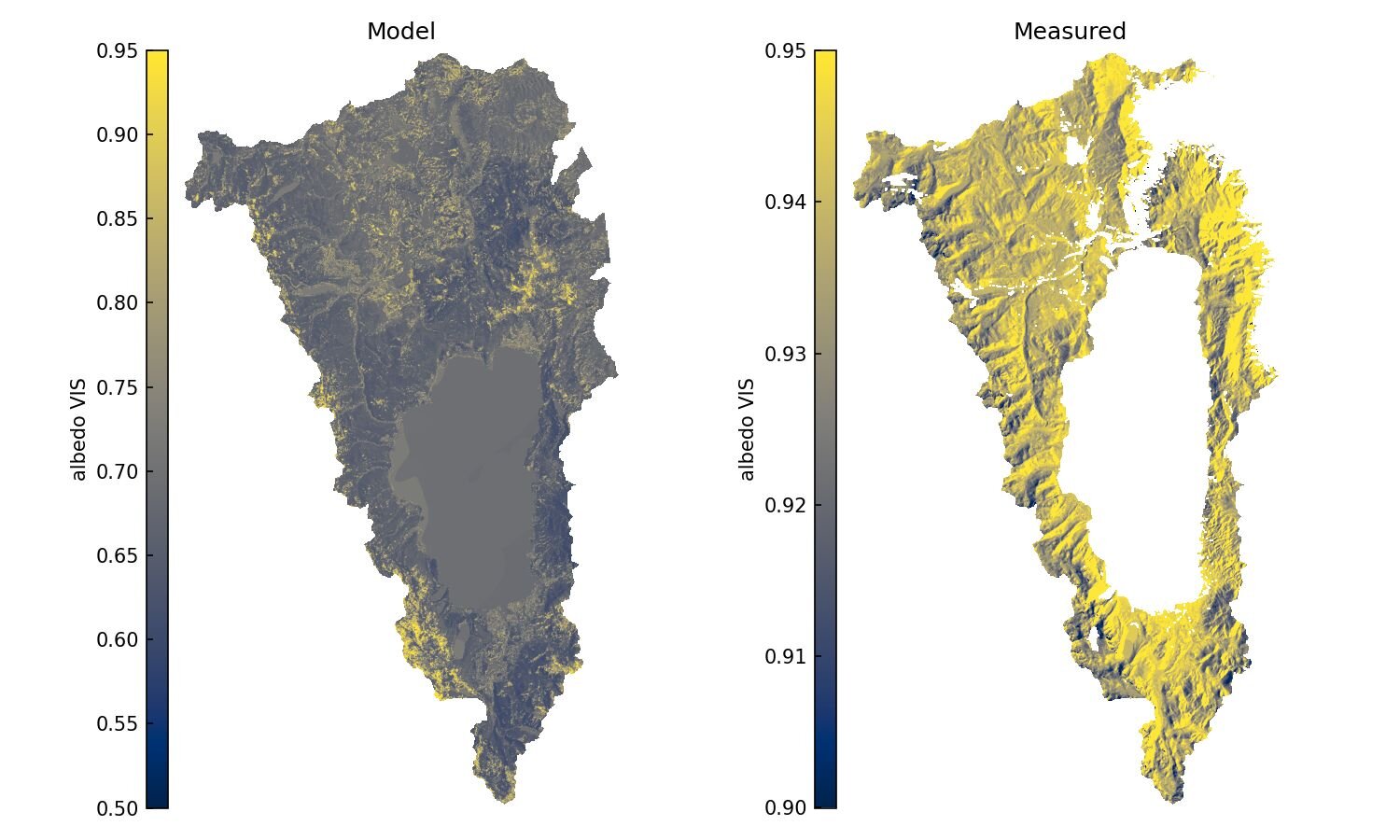
Snowpack models only make a difference if the predictions they produce are accurate. Very accurate. The fusion of aerial snow depth measurements and real time modeling with iSnobal remains our community's most accurate way to estimate water resources stored in snow. M3Works continues to work closely with ASO, integrating close to a hundred aerial surveys each year. Since leaving the USDA, M3Works has made numerous improvements that better leverage the plethora of data from ASO Inc. As a result, iSnobal has become one of the most validated snowpack models ever written.
Exploring Extreme Years
One of the most significant applications of the iSnobal model is in understanding how snowmelt will respond to extreme weather events. By analyzing data from both wet and dry years in the Tuolumne River Basin in California, M3Works has gained insights into how snowmelt patterns are affected by environmental changes.
As water demand rises, extreme weather events add complexity to decision-making, challenging resource management and sustainability efforts. These variable conditions lead to significant changes in snowpack accumulation and melt, with large downstream effects for water planning. In years with higher amounts of snowfall, extended periods of high runoff are common, posing flood risks. Additional risk is possible with incoming weather that can cause further spikes in runoff. This risk is partially dependent on the spatial distribution and current temperature of the snowpack, which are insights derivable from iSnobal.
During dry years, the snowpack generally accumulates later and melts earlier in the spring. Accurately understanding the volume of snow in the mountains increases understanding of the severity of ensuing drought conditions.
The Future of M3Works: Expanding iSnobal As A Service
M3Works remains committed to expanding the capabilities of iSnobal and making it more accessible to a broader audience. Working at the USDA, spring boarded M3Works to now run a cloud-based service that allows users to access powerful snowpack predictions without requiring specialized expertise. More and more communities across the United States are benefitting from this service.
As water management becomes more interconnected, M3Works believes iSnobal will become increasingly important for ensuring that people have access to the water they need.
Micah Sandusky is a software developer, mechanical engineer, and scientific modeler. He started out using computational fluid dynamics to estimate wind power in mountainous terrain. He later launched into a snow hydrology career when he joined the USDA Agricultural Research Service to serve as the primary developer for the Automated Water Supply Model (AWSM), a framework now used by M3. Prior to cofounding M3 Works, Micah spent time as a developer in the commercial software industry where he cultivated his skills with data pipelines in the Cloud. At M3 Works, Micah coordinates our cloud infrastructure while developing new strategies for monitoring/maintaining our real time efforts to estimate snowpacks all across the Western US.
- M.S. Mechanical Engineering
- 10 years scientific modeling
- 10 years development experience
- 4+ years of Cloud experience

Solutions
Company
Resources
© 2024 M3Works. All rights reserved.